As an ADR practitioner accredited by the Ministry of Constitutional and Legal Affairs, I have encountered different views on the practical meaning of section 13 of the Civil Procedure Code, Cap. 33 R.E. 2023. In my view, reading subsections (1) to (4) together provides a clearer understanding of the obligation placed on a person before commencing court proceedings.
What Constitutes a Bona Fide Step?
Section 13(2) provides practical examples of steps that a person may take to resolve a dispute before going to court. These include notifying the other party of the issues in dispute and offering to discuss them, responding appropriately to such notification, exchanging relevant information and documents, and considering whether the dispute can be resolved through another process rather than court action.
The provision specifically recognises processes such as reconciliation, negotiation, mediation, arbitration, warning and diversion, where applicable. Where the parties agree to use a particular process, they may also agree on the person who will facilitate it and should attend the process. If the agreed process does not resolve the dispute, the parties may consider another process. The provision also recognises attempts to reconcile, negotiate or otherwise resolve some or all of the issues before escalating the matter to mediation or arbitration.
Therefore, section 13(2) demonstrates that a bona fide step is not limited to mediation. Different steps may be appropriate depending on the nature and circumstances of the dispute.
Similarly, the nature of the dispute may determine the appropriate bona fide step. In a matrimonial dispute, for example, the parties may be required to approach the Marriage Conciliation Board, where the conciliator facilitates the process. In a construction dispute, the parties may be required to refer the dispute to an adjudicator for adjudication, particularly where this is provided for in their contract.
What Makes a Step Bona Fide?
Section 13(1) provides the test. A person is deemed to have taken bona fide steps where the steps taken constitute a sincere and genuine attempt to resolve the dispute out of court, having regard to that person's circumstances and the nature and circumstances of the dispute.
The important point is therefore the genuineness of the attempt. A party should not merely perform a formal act to create the appearance of compliance. The other party should be given a reasonable opportunity to participate in an attempt to resolve the dispute.
Section 13(3) Keeps the List Open
Section 13(3) removes any doubt that the bona fide steps in subsection (2) are exhaustive. It provides that subsection (1) does not limit the steps that may constitute taking bona fide steps to resolve a dispute.
This means that the Court should not ask only whether the claimant used mediation, negotiation, reconciliation or another specific process. The broader question is whether the claimant made a sincere and genuine attempt to resolve the dispute out of court.
Section 13(4) Applies to All Court Proceedings
Section 13(4) is particularly important. It provides that “the provisions of this section shall apply to all proceedings intended to be initiated in court.”
The use of the word “shall”, together with the words “all proceedings”, makes the scope of section 13 clear. The requirement is not limited to particular categories of disputes or to cases where the parties have expressly agreed to mediation. A person intending to initiate proceedings in court must first comply with the bona fide mandatory statutory requirement under section 13.
The practical question is therefore not whether a particular ADR mechanism was compulsory. The question is whether the person intending to go to court took a sincere and genuine step to resolve the dispute out of court?
How is Compliance Proven?
Section 13 does not prescribe a particular certificate as proof of compliance. In practice, however, the document generated from the process can provide evidence that the bona fide step was actually taken.
The appropriate document may depend on the process used:
- Arbitration: Arbitral award.
- Adjudication: Adjudicator's decision.
- Mediation, conciliation or negotiation: Certificate of settlement or non-settlement from the relevant and accredited ADR practitioner.
These documents provide practical evidence of the process undertaken, the parties involved, the date, and the outcome. They should be regarded as evidence of compliance, not as additional statutory conditions.
ADR practitioners are accredited by the Ministry of Constitutional and Legal Affairs under Regulation 15(2) of the Reconciliation, Negotiation, Mediation and Arbitration (Practitioners Accreditation) Regulations, 2021.
The Court may therefore ask:
What genuine step did the person intending to institute proceedings take to resolve the dispute before coming to Court, and what credible evidence demonstrates that the step was taken?
Conclusion
From my practical viewpoint as an ADR practitioner, all civil disputes intended to be initiated in a court of law should first comply with section 13 of the Civil Procedure Code. This position is particularly supported by section 13(4), which expressly provides that the section “shall apply to all proceedings intended to be initiated in court.”
The requirement is therefore to take a sincere and genuine bona fide step to resolve the dispute before commencing litigation. The particular bona fide step or mechanism is optional according to the nature and circumstances of the dispute, applicable law, or a binding contractual provision. What is mandatory is the bona fide attempt (a sincere and genuine attempt to resolve the dispute out of court) before the matter is taken to a court of law. But if you are not intending to initiate the dispute before the court of law, then the bona fide attempt is not mandatory.
Written by: Mr. Erick Mukiza
Mediator Accredited by the Ministry of Constitutional & Legal Affairs
Executive Director of ESS CREATIVE AND LEGAL FOUNDATION
Disability Inclusion Expert
Member of the Association of Young Arbitrators (AYA)
A spring 2024 Professional Fellow of the Inclusive Civic Engagement US-government funded exchange program
WIPO ADR Young Practitioner
www.esscreativeandlegalfoundation.org

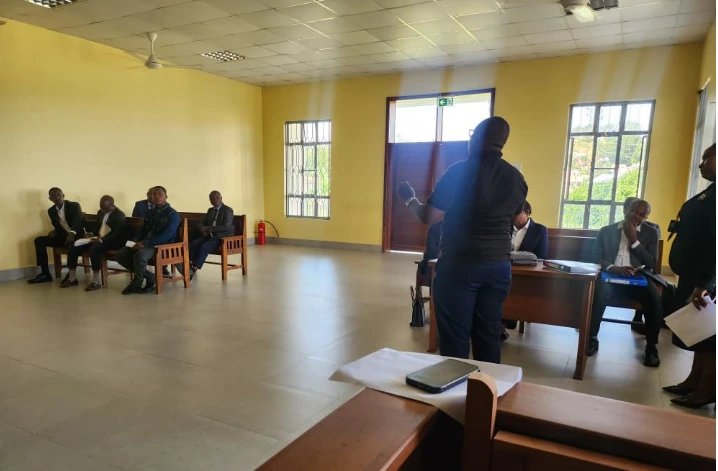
Magistrate in Charge, Hon. Tumsifu Barnabas introducing Erick Mukiza, Executive Director of ESS Creative and Legal Foundation and an Accredited Mediator to private advocates at Ubungo District Court in Dar es Salaam during the mediation workshop